Statement of Accountability from Andrea Ritchie
I would like to once again extend my deepest gratitude to everyone who joined us [October 7] for your presence and for extending yourselves, opening to new and challenging ideas, and taking risks to practice toward liberatory futures.
I would also like to express deep appreciation and respect to those who offered me the gift of sharing the impact of a statement I made during my presentation, and the opportunity to step into accountability through acknowledgment, correction, and moving toward repair.
When affirming a comment from the audience about the origins of policing in this country in the control, containment, repression, and punishment of enslaved and free people of African descent, I raised the reality that police forces in what is now known as the "United States" were also formed to enact a settler colonial genocide against Indigenous peoples, and to control, contain, repress, and punish any efforts to resist.
In this context, I described reservations as "open air prisons," referring to colonial era policing of movements of Indigenous peoples about the lands they have stewarded since time immemorial through military confinement on reservations, enforcement of pass systems, and the existence of "Indian police" who were created to control the presence of Indigenous people in urban areas. In doing so, I failed to note that what I was describing using this phrase was limited to particular reservations during a specific historical period, and that the present reality of reservation life is much more complex. Reservations have also been and are now spaces where many Indigenous peoples exercise sovereignty, experience freedom, and honor and preserve ancestral and traditional Indigenous languages and life ways free from colonial control - in other words, for many, they are spaces of rootedness, sovereignty, empowerment, and practicing new worlds. And for many, experiences of reservation life are a mix of positive , neutral, and negative experiences shaped by the continuing legacies of occupation and colonialism.
My careless description of reservations misrepresented these complex realities by making a gross generalization across time and space that was harmful to Indigenous people in and beyond the room who were raised on and connected to reservations, and whose experiences are not reflected in the phrase I used, who experience stigma and discrimination from white settler society for having been raised or living on reservations, and who are routinely criminalized across institutions and communities regardless of their relationship to reservations. The impact of my statement was compounded by the reality that I am a light skinned child of settlers and migrants to these lands with extremely limited experience or understanding of reservation life, past, present, and future.
I want to offer my sincere apologies to all who were impacted and shaped by this statement, and express my willingness to step into repair beyond acknowledgment of the impacts of my words and commitment to making every effort not making this mistake again in the future and to continuing to honor, build, and strengthen shared paths toward mutual accountability and collective liberation among Indigenous peoples and people of African descent living on Turtle Island, and deep gratitude for openness to receiving this message.
With care, in struggle, toward liberatory futures,
Andrea
Resources from Experience offered by Andrea Ritchie
Click Here to view or download the slide deck that Andrea Ritchie used to support the experience she offered.
Click Here to view or download the reflection handout from the experience.
Emblems from Complex Movements
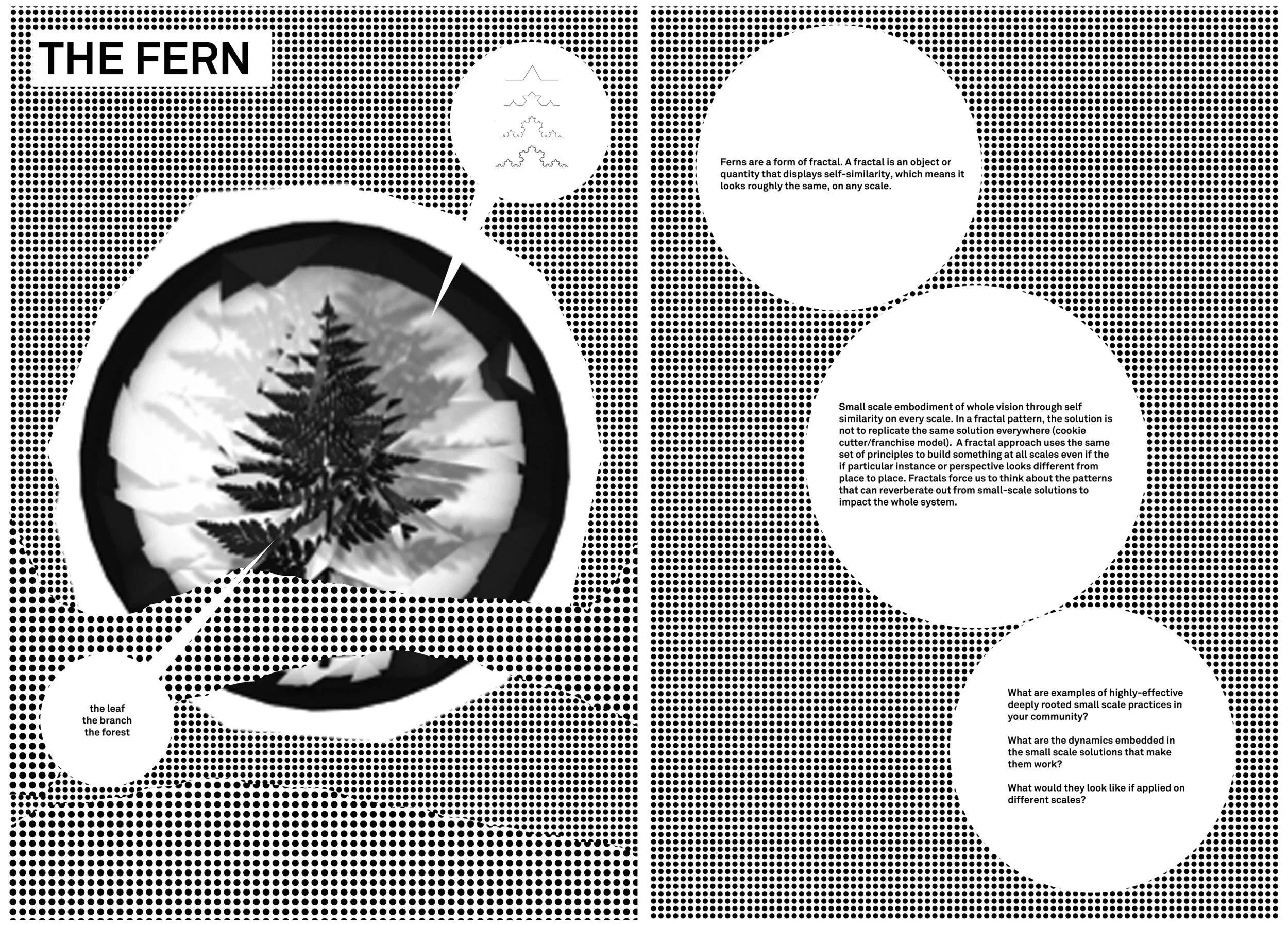
Ferns are a form of a fractal. A fractal is an object or quantity that displays self-similarity, which means it looks roughly the same on any scale.
Small scale embodiment of whole vision through self similarity on every scale. In a fractal pattern, the solution is not to replicate the sam solution everywhere (cookie cutter/franchise model). A fractal approach uses the same set of principles to build something at all scales even if the if particular instance or perspective looks different from place to place. Fractals force us to think about the patterns that can reverberate out from small-scale solutions to impact the whole system.
What are examples of highly-effective deeply rooted small scale practices in your community?
What are the dynamics embedded in the small scale solutions that make them work?
What would they look like if applied on different scales?
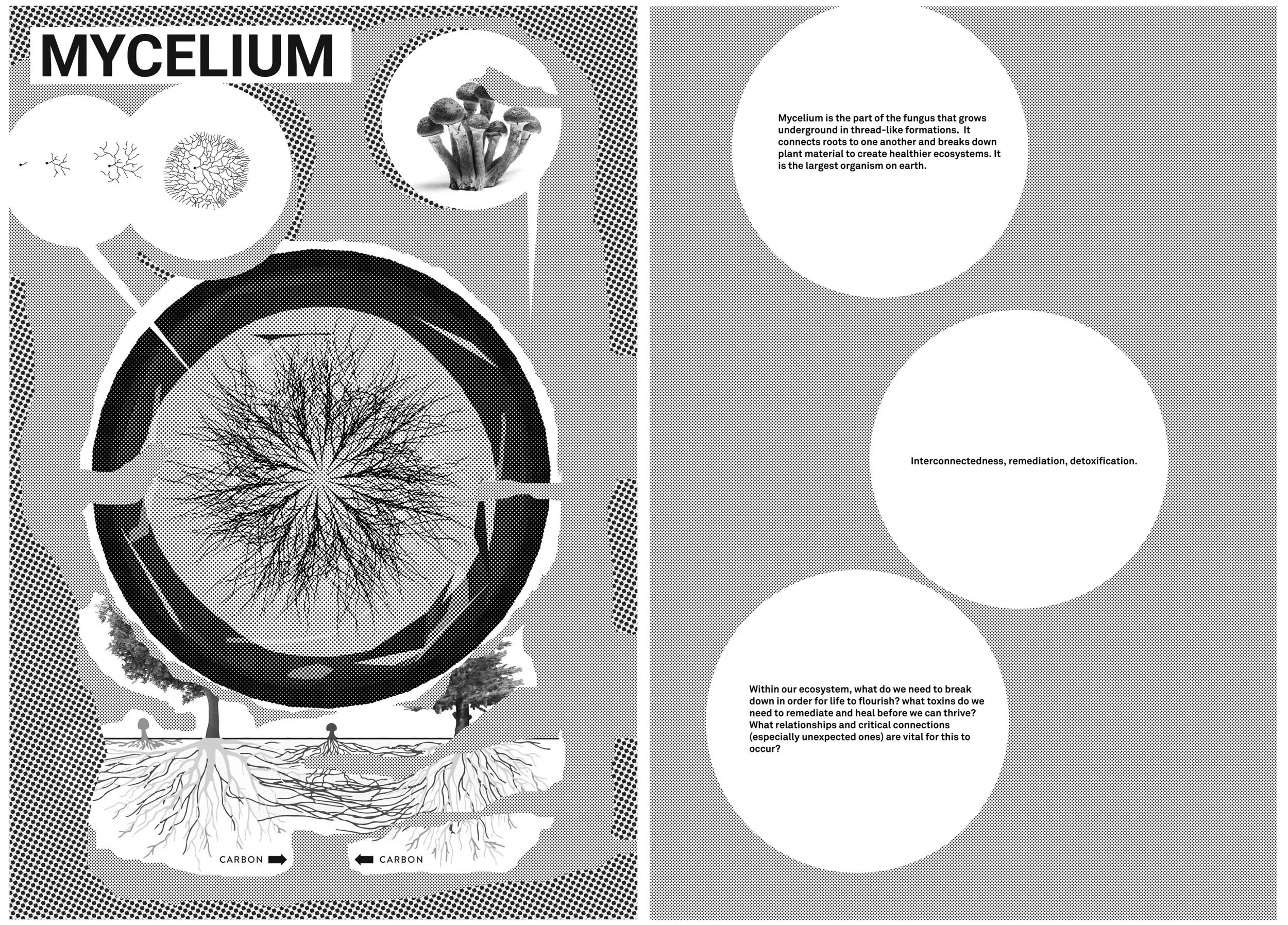
Mycelium is the part of the fungus that grows underground in thread-like formations. It connects roots to one another and breaks down plant material to create healthier ecosystems. It is the largest organism on earth.
Interconnectedness, remediation, detoxification.
Within our ecosystem:
What do we need to break down in order for life to flourish?
What toxins do we need to remediate and heal before we can thrive?
What relationships and critical connections (especially unexpected ones) are vital for this to occur?
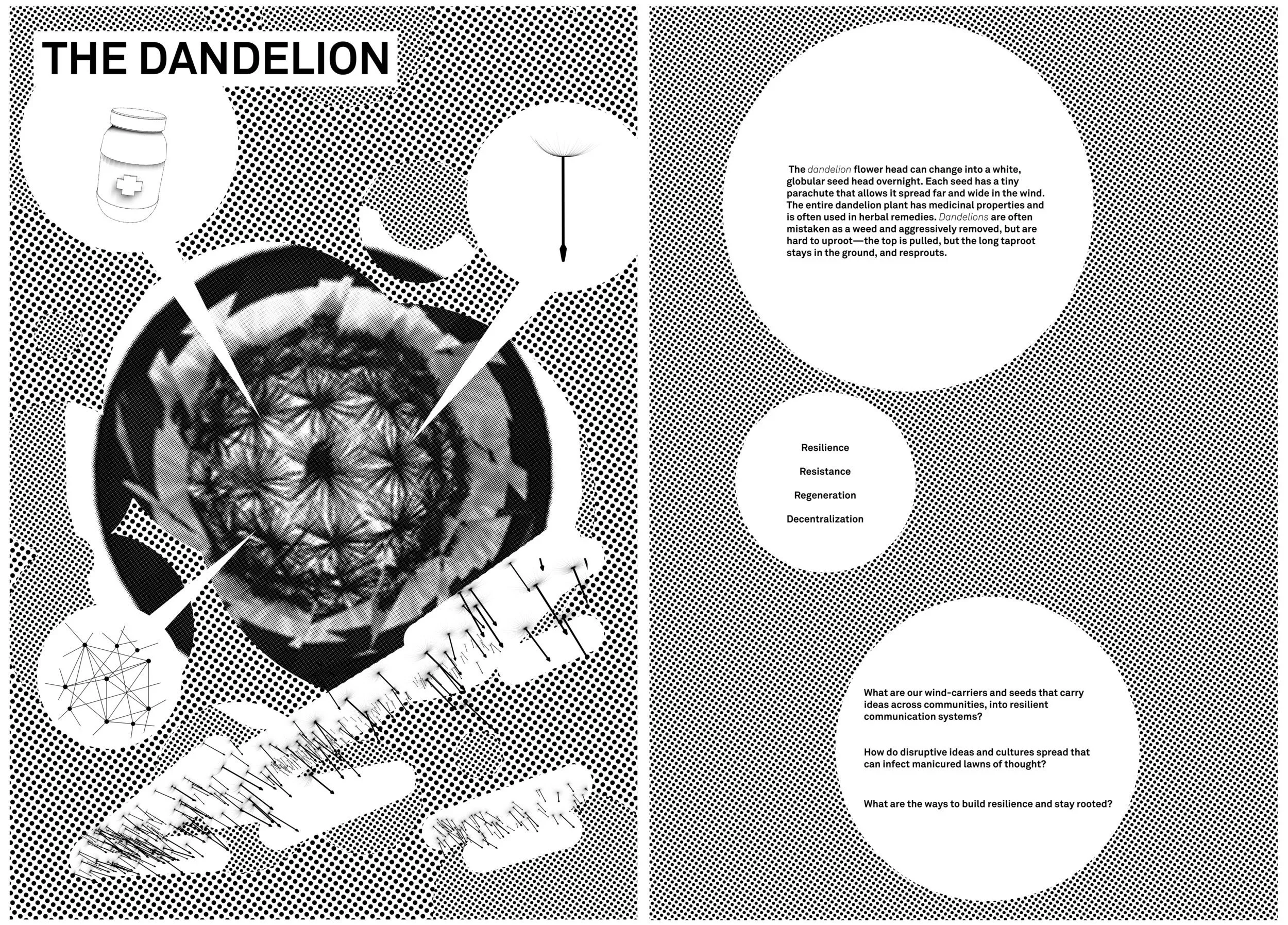
The dandelion flower head can change into a white, globular seed head overnight. Each seed has a tiny parachute that allows it spread far and wide in the wind.
The entire dandelion plant has medicinal properties and is often used in herbal remedies. Dandelions are often mistaken as a weed and aggressively removed, but are hard to uproot-the top is pulled, but the long taproot stays in the ground, and re-sprouts.
Resilience
Resistance
Regeneration
Decentralization
What are our wind-carriers and seeds that carry ideas across communities, into resilient communication systems?
How do disruptive ideas and cultures spread that can infect manicured lawns of thought?
What are the ways to build resilience and stay rooted?
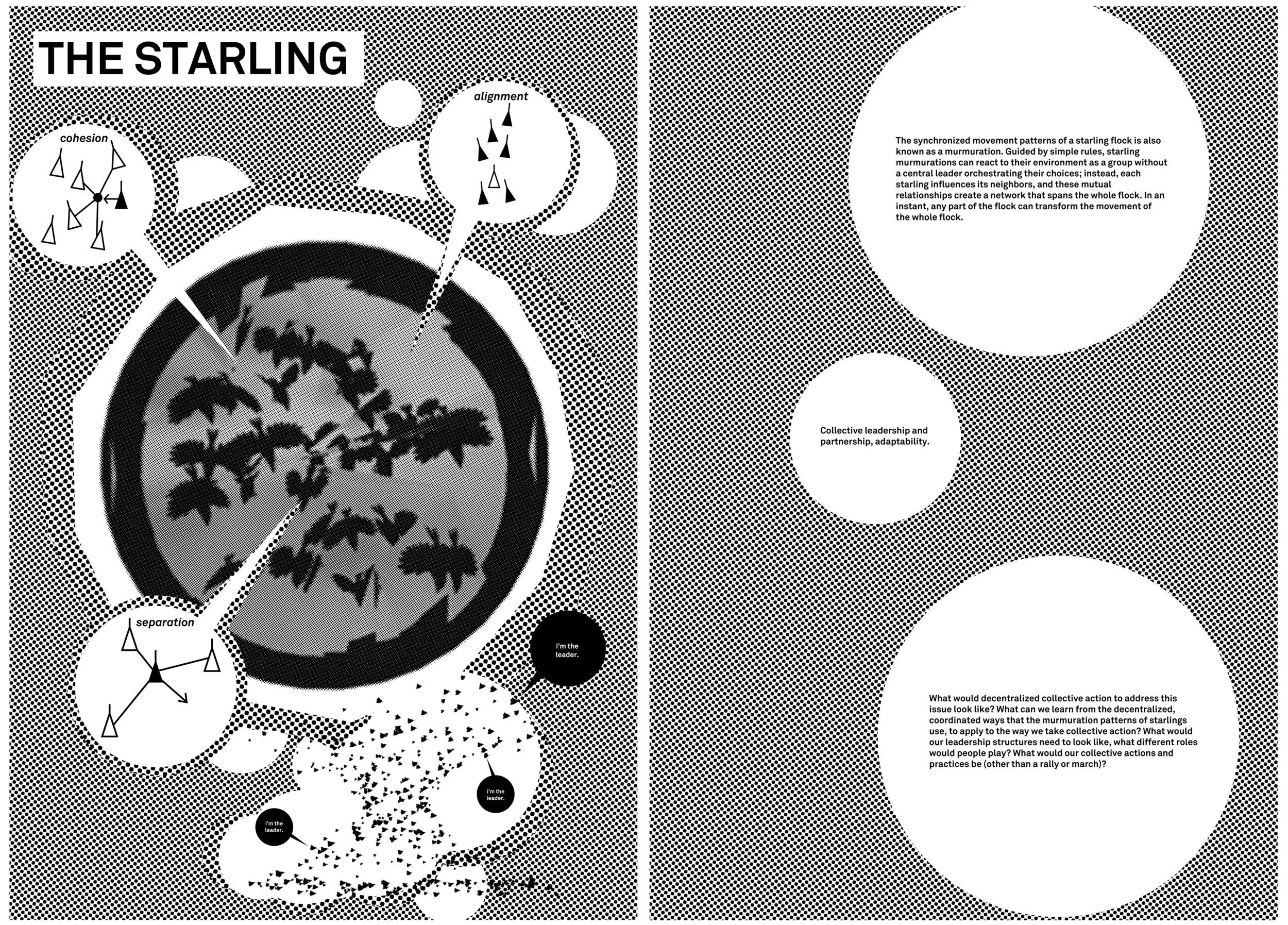
The synchronized movement patterns of a starling flock is also known as a murmuration. Guided by simple rules, starling murmurations can react to their environment as a group without a central leader orchestrating their choices ; instead, each starling influences its neighbors, and these mutual relationships create a network that spans the whole flock.
Collective leadership and partnership, adaptability.
What would decentralized collective action to address this issue look like?
What can we learn from the decentralized, coordinated ways that murmuration patterns of starlings use, to apply to the way we take collective action?
What would our leadership structures look like?
What different roles would people play?
What would our collective actions and practices be (other than a rally or march)?
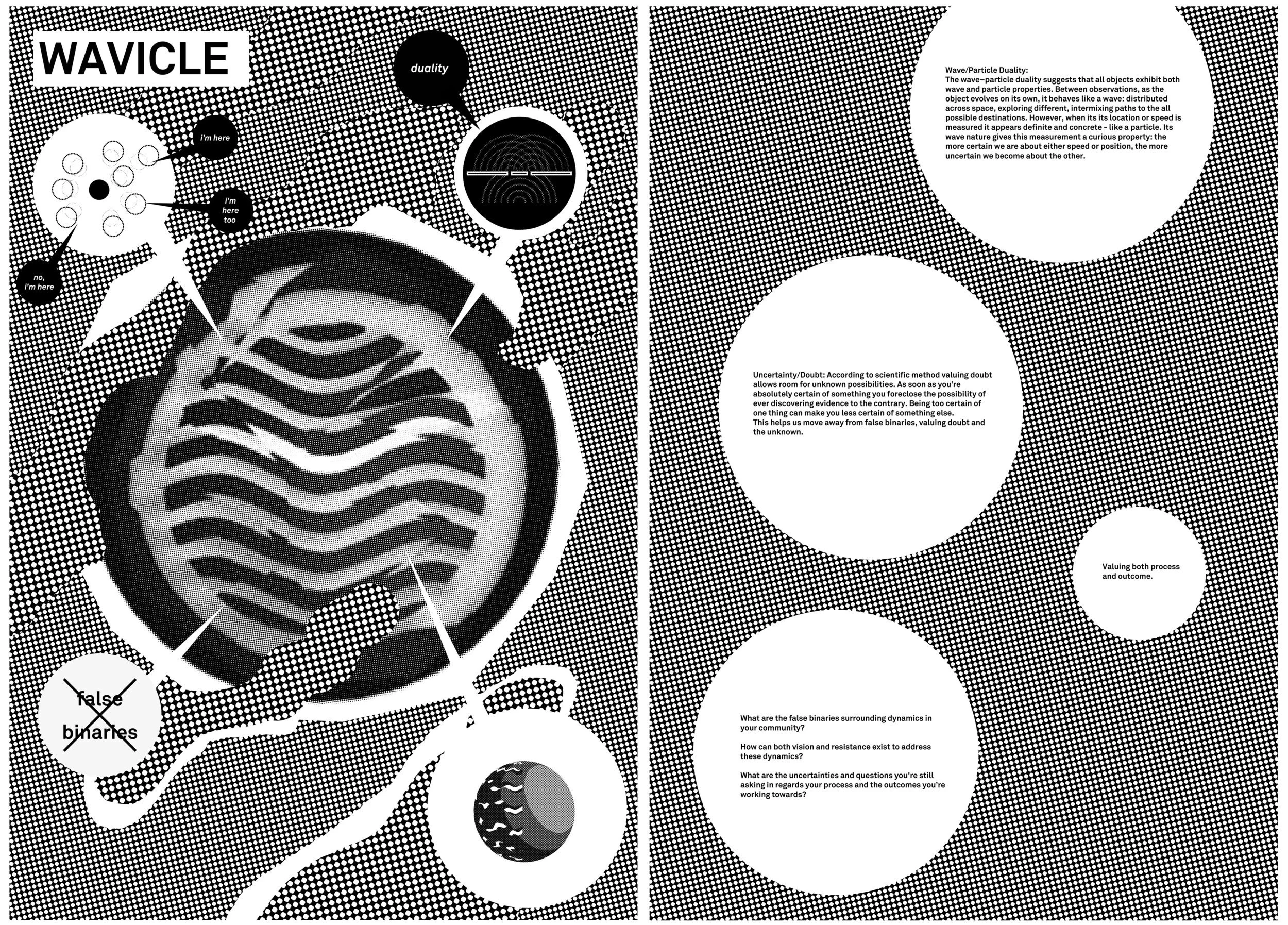
Wave/Particle Duality:
The wave-particle duality suggests that all objects exhibit both wave and particle properties. Between observations, as the object evolves on is own, it behaves like a wave: distributed across space, exploring different, intermixing paths to the all possible destinations. However when its its location or speed is measured, it appears definite and concrete - like a particle. Its wave nature gives this measurement a curious property: the more certain we are about either speed or position, the more uncertain we become about the other.
Uncertainty/Doubt:
According to scientific method valuing doubt allows room for unknown possibilities. As soon as you're absolutely certain of something you foreclose the possibility of ever discovering evidence to the contrary. Being too certain of one thing can make you less certain of something else
This helps us move away from false binaries, valuing doubt and the unknown.
Valuing both process and outcome.
What are the false binaries surrounding dynamics in your community?
How can both vision and resistance exist to address these dynamics?
What are the uncertainties and questions you’re still asking in regards to your process and the outcomes you’re working towards?
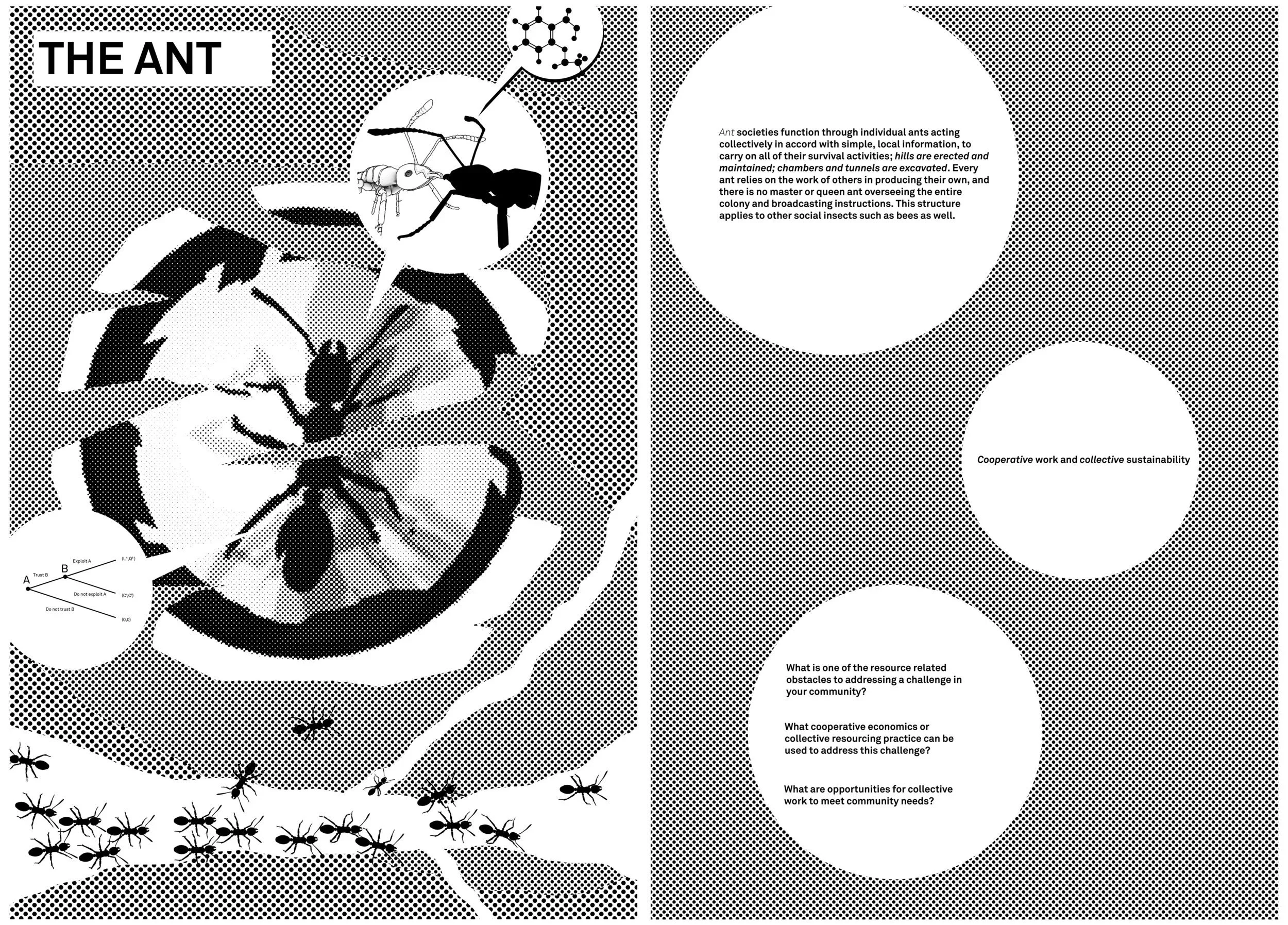
Ant societies function through individual ants acting collectively in accord with simple, local information, to carry on all of their survival activities; hills are erected and maintained; chambers and tunnels are excavated. Every ant relies on the work of others in producing their own, and there is no master or queen ant overseeing the entire colony and broadcasting instructions. This structure applies to other social insects such as bees as well.
Cooperative work and collective sustainability.
What is one of the resource related obstacles to addressing a challenge in your community?
What cooperative economics or collective resourcing practice can be used to address this challenge?
What are opportunities for collective work to meet community needs?

Additional Resources for Continued Engagement & Practice